Define the business task, the evidence you will trust, the exact SKU and region, the full cost of ownership, and who owns support — before you compare a China-origin AI hardware quotation.
This page is the CNPS.AI China → buyer method for enterprise AI procurement. It is written for foreign and enterprise buyers evaluating a China-origin device supplier (for example TicNote recording hardware published on CNPS.AI), not a generic consulting checklist. Availability, commercial terms, and implementation scope are confirmed during quotation. Industry references elsewhere on this site are not claims that CNPS delivered those projects.
Who this checklist is for
Use this checklist when you are:
- Buying team or channel sample AI recording devices, or scoping a small hardware pilot from a China supply path
- Comparing unit price against subscriptions, logistics, destination charges, training, and support
- Deciding whether to sample first or jump to a bulk purchase order
If you already know you need a UAE/KSA recording path with bilingual meeting-notes gates, use the dedicated Gulf sourcing method after you freeze the workflow here: Source China AI recording hardware for UAE/KSA without skipping the pilot. If your project is a camera / edge site, complete site readiness before selecting a box: UAE/KSA edge AI site readiness before you pick a box.
The eight China → buyer steps
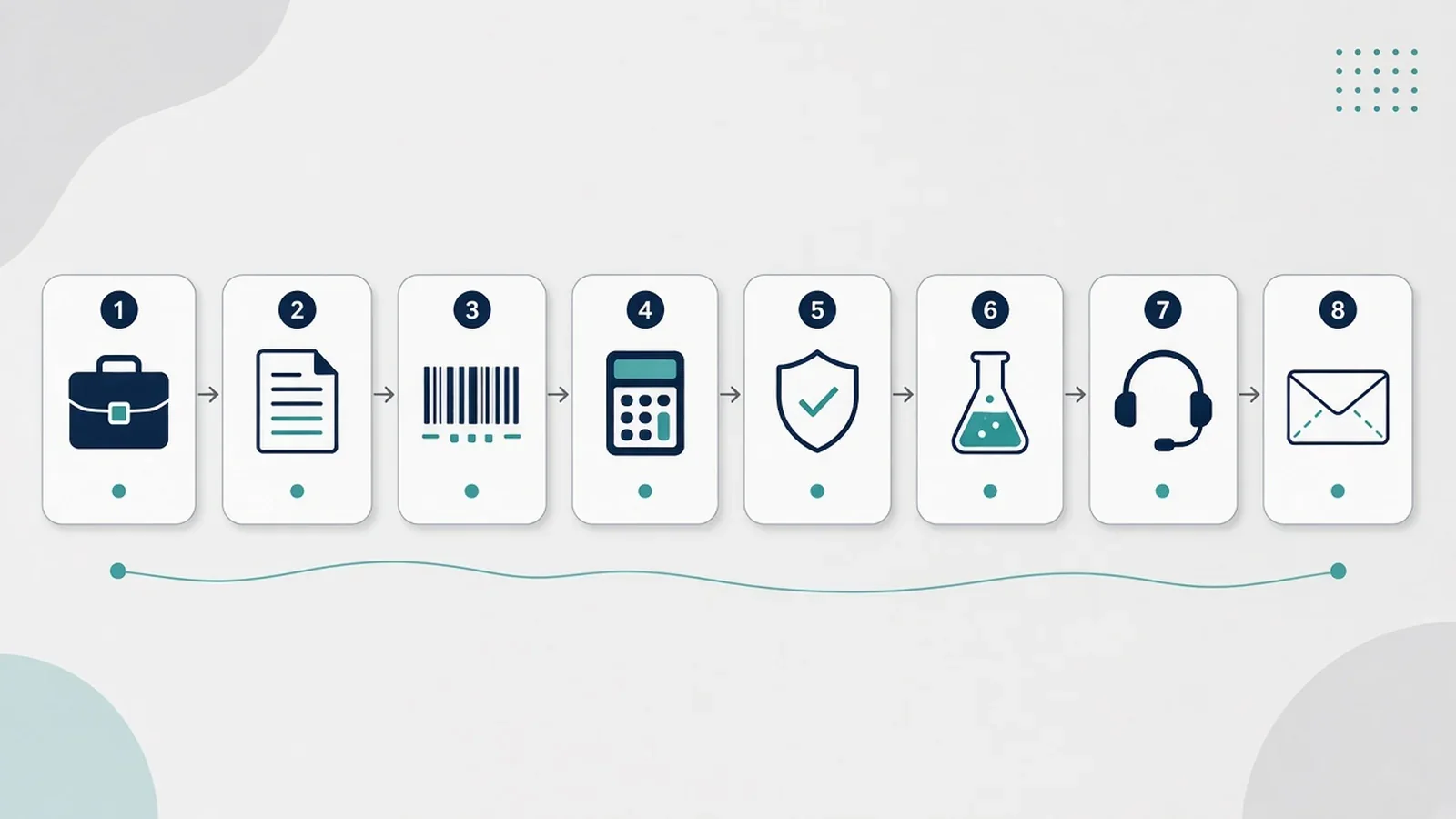
1. Freeze the job — not the model name
Write the task in one paragraph before you open a catalog:
- Which task should improve, and who performs it today?
- What is your baseline cost, time, or error rate?
- Who will use the system, approve the trial, and sign procurement?
- Destination country, languages, working environment, and data constraints?
- What would make the project unsuitable even if a demonstration looks good?
A product category, a SKU name, or a demo video is not a complete requirement. CNPS positions itself as an entry point to select, validate, and coordinate procurement of Chinese AI applications and hardware — the website helps you define the problem first; supply and after-sales are confirmed before they become contractual commitments. Start from the brand hub if you are still choosing a path: CNPS.AI.
Enquiry-ready inputs: company · destination country · task in one sentence · user or site count · target timeline · hard constraints (language, offline need, data residency questions).
2. Ask for evidence that matches the decision
Match evidence type to what you are deciding. Do not treat a polished demo as proof of your acceptance criteria.
| Evidence | Useful for | Still needs checking |
|---|---|---|
| Official product documentation | Features and supported configurations | Exact SKU, region, firmware or app version |
| Store / catalog listing | Published form factor, plan options, live price band | Whether that listing matches your destination and account type |
| Vendor customer story | A reported use case | Measurement method and applicability to your site |
| Demonstration video | Understanding a possible workflow | Failure conditions and repeatability |
| Your own pilot | Testing the actual requirement | Representative data, agreed acceptance, excluded work |
An industry reference on this site is not a claim that CNPS delivered the project or represents the upstream vendor. Prefer evidence you can archive: document URL, date, SKU identifier, and who signed off.
3. Lock SKU, region, version, and subscription ownership
China-origin hardware often ships with region-specific radios, plugs, language packs, cellular variants, or app account rules. Before you compare quotations:
- Name the exact SKU (and color / plan / cellular variant if published)
- Confirm the destination country matches what the listing or quotation covers
- Record firmware, app, and subscription ownership: who pays monthly minutes or seats, who can reassign devices, who can export or delete data
- Ask what happens when the network fails or a connected service ends
For TicNote retail SKUs published by CNPS, compare live form factors and plan options on the store collection before you assume an enterprise pack: All TicNote Products. Enterprise buying is not always a larger retail cart — account administration and device reassignment may decide suitability.
Enquiry-ready inputs: candidate SKU(s) · destination country · languages to test · offline / connected preference · who owns the subscription.
4. Compare the whole quotation (TCO), not the device line
Include at least:
- Hardware and accessories
- Subscriptions, model or speech services, account seats or minutes
- Installation, training, configuration time
- Logistics, insurance, destination charges, taxes under your trade terms
- Support, spare / replacement path, expected return or warranty cost
Identify which party owns each responsibility: you, CNPS, the manufacturer, or a local partner. Check what changes if usage doubles — or if only half the expected users adopt the system. A cheap device with high support cost is a poor buy.
Enquiry-ready inputs: pilot quantity vs bulk quantity · currency preference · Incoterms or delivery assumption you want quoted · one-time vs recurring line items you must see separately.
5. Name compliance and trust documents early
Determine obligations by product, destination market, use case, and legal role — not by a generic “AI certified” label. Ask for documents that match the actual SKU:
- Product identity and authorization chain for the model you will receive
- Wireless / electrical / battery materials applicable to your market (for example FCC or CE evidence when those markets apply) — matching the model, not a similar module
- Data-flow explanation: what is collected, where it is stored, who can access it, retention, deletion, and subcontractors
- Recording / vision projects: your lawful-use and notice procedures (technical capability is not permission to collect)
Public pages must not invent certificates CNPS has not published. Treat missing documents as a quotation blocker, not a footnote.
6. Agree a small, useful pilot before a bulk PO
Record inputs, configuration, test conditions, success metrics, and failures. Include difficult examples. Agree acceptance before the test. Keep an explicit list of excluded work.
Practical pilot shape for meeting devices:
- Freeze scope and baseline (days 1–2)
- Configure devices and accounts (days 3–5)
- Run representative meetings in your languages and rooms (days 6–8)
- Independent acceptance against the written scorecard (days 9–10)
Passing a finite sample does not prove every future meeting. It proves whether you should scale, change SKU, or stop.
Enquiry-ready inputs: pilot quantity · acceptance owner on your side · success metrics · failure examples you will include · excluded work.
7. Map support, repair, and delivery responsibilities
Cross-border hardware needs advance answers on plugs, power, radio bands, manual languages, lithium-battery transport, repair returns, and replacement units. Ask:
- Who is first contact when a device fails?
- What is the return / RMA path to China vs local swap?
- What languages can support staff use for your team?
- What is in writing for warranty vs goodwill replacement?
Until those items are confirmed, public wording should stay at “confirm support arrangements in writing” — not an invented SLA.
8. Send an enquiry that sales can quote
A useful enquiry is a work item, not an inbox greeting. Include at least:
| Field | Why it matters |
|---|---|
| Company and reply contact | So a human can answer |
| Destination country | SKU, logistics, compliance |
| Intended use | Fit to product or solution path |
| Pilot quantity or user / site count | Sample vs project routing |
| Timeline | Queue and supply checks |
| Constraints | Language, offline, data, budget guidance optional |
Share those details through Start a conversation, or email sales@cnps.ai / call +86 183 5463 9099. Sales should return candidate options, key unknowns, and proposed next acceptance steps — not only a unit price.
China-origin supplier vs generic AI checklist
| Decision gate | Generic AI checklist often stops at | China → buyer method on this page |
|---|---|---|
| Requirements | “Use AI for meetings / knowledge” | Named task, baseline, unsuitable conditions |
| Evidence | Demo and brochure | SKU-matched docs + your pilot |
| Commercial | Hardware unit price | TCO lines + responsibility matrix |
| Risk | Brand reputation | Region / radio / data-flow / RMA path |
| Scale | Bulk PO after demo | Written acceptance on a small pilot |
For the wider CNPS research framing (why overseas buyers place orders, RFQ fields, pilots, compliance gates, and revision history), read the companion once: China AI: the CNPS global expansion playbook.
FAQ
What is an AI procurement checklist for enterprise buyers?
It is a decision sequence you run before comparing quotations: freeze the job and acceptance test, demand evidence that matches that decision, lock SKU and region, price the full cost of ownership, confirm support and compliance documents, run a small pilot, then send a structured enquiry. This page applies that sequence to China-origin AI hardware paths CNPS publishes — not to abstract model selection alone.
How is enterprise AI procurement different from buying a retail AI recorder?
Retail checkout fits when you already chose a standard SKU and destination. Enterprise procurement adds acceptance owners, subscription ownership, bulk logistics, destination compliance, support responsibilities, and often a paid or sample pilot. You may still start from published TicNote listings, then request a bulk or pilot quotation with the fields above.
What should I send CNPS before asking for a quotation?
Company, destination country, intended use, pilot quantity or user count, target timeline, and main constraints. Optional: candidate SKU, languages to test, and whether you need offline behavior documented. Budget can be “need guidance.” Do not upload confidential materials as a condition of first contact.
Can a demonstration video replace a pilot?
No. A demonstration helps you understand a possible workflow. It does not prove failure conditions, your room acoustics, your languages, or your account and export rules. Agree acceptance criteria, then run your own pilot with difficult examples included.
What total cost items do buyers forget on China AI hardware?
Subscriptions or transcription minutes, training time, freight and destination charges, import responsibilities under your trade terms, spare units, return shipping for repair, and the cost of low adoption (hardware paid for users who never use the system). Ask for one-time and recurring lines separately.
How do I evaluate a China-origin supplier on trust without inventing certificates?
Request documents that match the exact model you will receive, a clear company contact path, a data-flow explanation you can review, and written support terms. Treat missing SKU-matched evidence as a blocker. Do not accept “similar model” certificates or unverified AI performance percentages as substitutes.
When should I use the Gulf recording guide instead of this page alone?
When your destination is UAE or KSA and your workflow is meeting notes / recording hardware with bilingual quality gates. Complete this checklist’s job and sample gates first, then follow the Gulf sourcing method linked above before a bulk PO. Edge camera projects should use the UAE/KSA site readiness guide before selecting hardware.
Next step
You now have a China → buyer sequence you can run on the next quotation: job → evidence → SKU/region → TCO → compliance → pilot → support → structured enquiry. Open the TicNote collection when you need live retail SKUs; open the export playbook when you need the full CNPS research edition; send your company, country, task, quantity, and timeline when you are ready to discuss a pilot or bulk path.